 Washington Dental
Washington Dental Orthodontic Clinic in Gangnam, Seoul
Non-surgical skeletal orthodontics for adults
underbite · facial asymmetry · protrusion · receding chin
Not every underbite or facial asymmetry needs surgery. When the cause lies in the jaw joint and the bite, improvement can be attempted with orthodontic treatment alone.
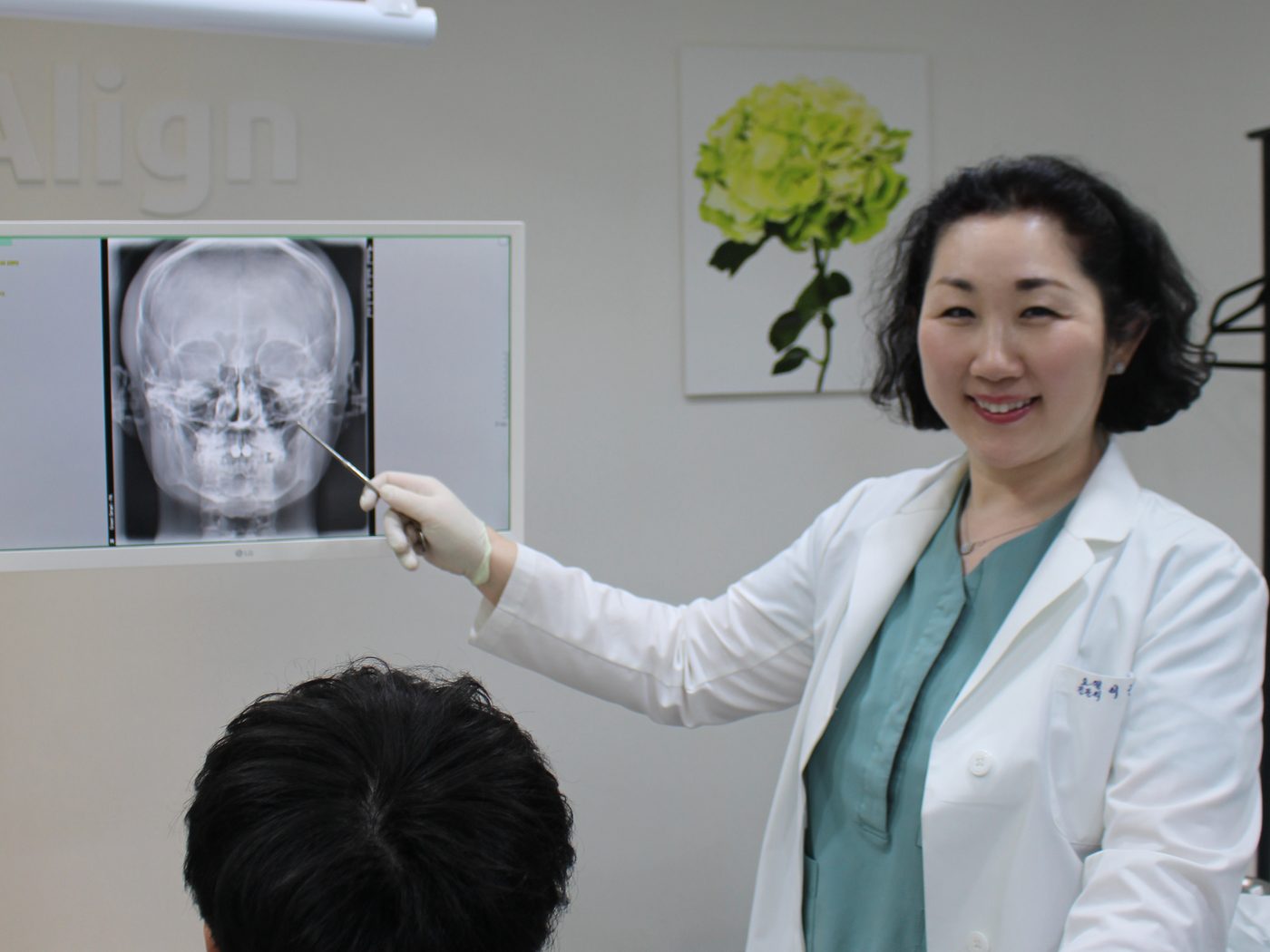
An adult underbite can sometimes be corrected without jaw surgery. If the lower jaw looks prominent because of the jaw-joint position or the way the teeth meet (a functional underbite), orthodontic treatment can be attempted. If the jawbone itself has overgrown, combined surgery may be needed. Cephalometric X-ray analysis tells the two apart.
Non-surgical skeletal orthodontics in brief
- ConditionsUnderbite, facial asymmetry, lip protrusion, receding chin, gummy smile, deep bite and open bite
- When surgery can be avoidedWhen the jaw-joint position or the bite is the cause, non-surgical correction is possible. When the bone itself is the cause, the need for combined surgery is decided after diagnosis.
- DiagnosisPanoramic and cephalometric X-rays, bite analysis and a jaw-joint check, followed by a treatment plan
- Typical durationGenerally 6 months to 2 years and 6 months depending on the type and severity (individual estimate at diagnosis)
- Treating doctorDr. Keun-Hye Lee, board-certified orthodontic specialist, sees you personally · +82-2-552-3000
Conditions and how we approach them
The same symptom can be treated very differently depending on whether it comes from the teeth, the jaw bones or the jaw joint.
| Condition | What it is | Main treatment approach |
|---|---|---|
| Facial asymmetry | The left and right sides differ from the facial midline, or the chin deviates to one side. Often caused by habits, the jaw joint or the bite. | Check the jaw-joint position and the bite first. If the bone itself is not the problem, attempt non-surgical correction. |
| Underbite | The lower front teeth bite in front of the upper teeth. Can affect speech and chewing. | Distinguish skeletal from functional causes. A functional underbite (jaw joint or bite) can be treated without surgery. |
| Lip protrusion | In profile, the mouth sits ahead of the line from the nose tip to the chin. Divided into dental protrusion and alveolar (bone) protrusion. | Dental protrusion often improves with orthodontics alone. Whether extraction is needed is decided by detailed diagnosis. |
| Receding chin | The lower jaw sits back or the chin looks small, so the chin appears retruded in profile. | After checking the jaw-joint position, improve the bite and mouth protrusion with orthodontics. If needed, premolars are extracted and the front teeth moved back. |
| Gummy smile | Too much gum shows when smiling. | Orthodontic treatment using mini-screws to reduce gum exposure. |
| Deep bite and open bite | In a deep bite the upper teeth cover the lower teeth too much. In an open bite the upper and lower front teeth do not meet. | Orthodontic treatment to prevent strain on the jaw joint, sometimes possible with clear aligners. Front and back teeth are extruded or intruded to correct the vertical overlap. |
Why facial asymmetry starts with the jaw joint
Many people who come in with facial asymmetry do not have a bone problem. The cause is a shift in the jaw-joint position and a collapsed bite. In these cases, orthodontic treatment that corrects the joint position and the bite can reduce chin deviation and asymmetry at the corners of the mouth. No face is perfectly symmetrical, so the goal is a functionally stable bite and a natural balance.
When an underbite can be corrected without surgery
Some adult underbites are not caused by an overgrown lower jaw. The lower jaw is pushed forward by the joint position or by how the teeth meet. This functional underbite can be treated non-surgically. Cephalometric (lateral skull X-ray) analysis shows whether the problem is skeletal, and when the skeletal component is large, we tell you clearly whether combined surgery should be considered.
Lip protrusion starts with one question, dental or skeletal?
In short, the same protrusion can need completely different treatment depending on its cause. Dental protrusion, where only the teeth are flared forward, often improves with orthodontics alone. Skeletal protrusion, where the alveolar bone itself projects, has limits with orthodontics and combined surgery may need to be reviewed. Orthodontics moves teeth. It does not move the jawbone. We identify the type with cephalometric measurements, then decide whether extraction is needed by measuring and simulating how far the teeth must move. We explain the pros and cons of extraction and non-extraction treatment and decide together with you.
The jaw joint is checked before treatment starts
In short, rushing into orthodontics while the jaw joint hurts is not recommended. Orthodontics and jaw-joint (TMJ) treatment are separate. If your jaw clicks, hurts or does not open fully, the joint and the bite should be evaluated first. At Washington Dental, the joint position is checked as part of every diagnosis for facial asymmetry, underbite and protrusion, and the treatment plan accounts for how bite changes will load the joint. Even a painless click is worth checking to see whether it is progressing.
A caution about "self-correction exercises" for asymmetry
Jaw-pushing exercises and chewing-muscle massage can help as a supporting measure for muscle-related asymmetry. But applied in the wrong direction they can make things worse, and they have clear limits for skeletal or dental asymmetry. We do not recommend self-treatment without identifying the cause (bone, teeth, muscles or habits). Correcting habits such as chewing on one side, resting your chin on your hand or sleeping face-down on one side is useful alongside a proper diagnosis.
Media coverage (in Korean)
- "Non-surgical correction of adult facial asymmetry draws attention", interview, Hinews (April 2026)
- "Choosing a non-surgical method for adult facial profile correction", column by Dr. Lee, Pharmnews (November 2023)
- "Facial asymmetry and underbite may be caused by the jaw joint, non-surgical treatment possible", interview, Seoul Economic Daily (February 2017)
Questions about non-surgical correction for adults
I was advised to have two-jaw surgery. Could orthodontics alone be enough?
Can adults have skeletal orthodontic treatment? Is there an age limit?
How long does non-surgical correction take?
My jaw clicks. Can I still start orthodontic treatment?
One clinic says I need extractions and another says I do not. How do I decide?
Read more
Last updated: October 2026 · Reviewed by Dr. Keun-Hye Lee, board-certified orthodontic specialist